
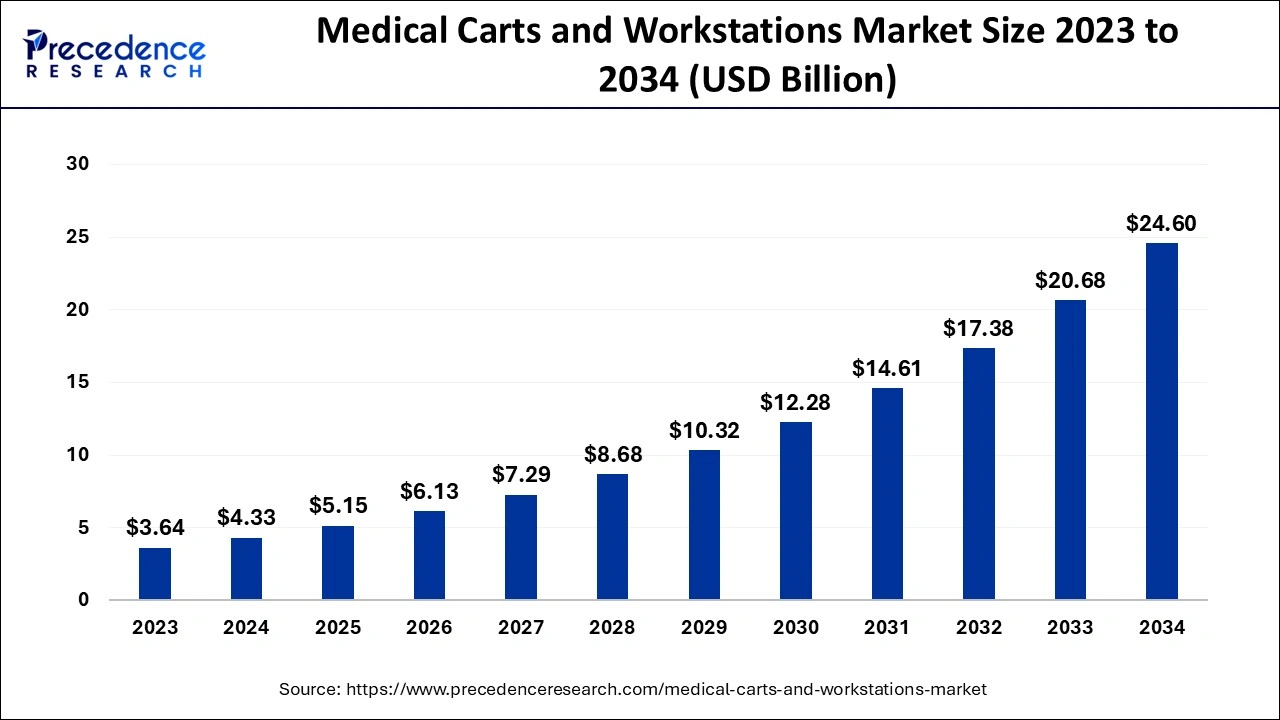
The global medical carts and workstations market was valued at USD 5.15 billion in 2025 and is expected to grow from USD 6.13 billion in 2026 to approximately USD 28.11 billion by 2035. The market is projected to expand at a compound annual growth rate (CAGR) of 18.50% during the forecast period from 2026 to 2035, driven by the increasing adoption of digital healthcare solutions, rising demand for point-of-care technologies, and the growing integration of electronic health records (EHRs) across healthcare facilities.
What are Medical Carts and Workstations?
Medical carts and workstations are mobile platforms designed to support healthcare professionals by securely transporting medical equipment, medications, and digital devices throughout healthcare facilities. They improve workflow efficiency by allowing clinicians to access patient information directly at the bedside instead of relying on fixed computer stations.
Depending on their intended application, medical carts may include medication storage, laptop or computer mounting systems, battery-powered workstations, emergency supplies, anesthesia equipment, laboratory tools, and telemedicine technology. Their mobility enhances communication between healthcare providers while reducing time spent moving between nursing stations and patient rooms.
These systems play an increasingly important role in supporting patient-centered care, minimizing documentation errors, improving medication safety, and streamlining hospital operations.
Get Sample Link: https://www.precedenceresearch.com/sample/1920
Market Overview
The global medical carts and workstations market is witnessing consistent growth due to increasing healthcare digitization, rising hospital admissions, expanding aging populations, and growing investments in healthcare infrastructure. Healthcare organizations worldwide are focusing on improving operational efficiency while ensuring better patient outcomes, creating significant opportunities for manufacturers.
The widespread implementation of Electronic Health Records (EHRs), computerized physician order entry systems, and barcode medication administration has significantly increased the demand for computer-enabled medical carts.
Growing concerns regarding healthcare worker fatigue have also encouraged hospitals to adopt ergonomic workstations with height-adjustable designs that reduce physical strain during long clinical shifts.
Furthermore, increasing healthcare expenditure in emerging economies continues to support new hospital construction and modernization projects, creating favorable conditions for market expansion.
Emerging Market Trends
- Smart Connected Medical Carts: Manufacturers are integrating Internet of Things (IoT) technologies into medical carts to enable remote monitoring, battery management, equipment tracking, and predictive maintenance.
- Lightweight Ergonomic Designs: Healthcare professionals often work long shifts that require frequent movement throughout hospitals. Manufacturers are increasingly developing lightweight aluminum carts with height-adjustable work surfaces, improved maneuverability, and ergonomic handles to reduce workplace injuries and improve user comfort.
- Advanced Power Management Systems: Battery-powered medical workstations now feature longer battery life, hot-swappable battery technology, rapid charging capabilities, and intelligent power monitoring systems. These improvements allow uninterrupted clinical operations throughout entire work shifts.
- Integration with Artificial Intelligence: Artificial intelligence is gradually being integrated into healthcare workstations through clinical decision support systems, voice recognition software, automated documentation, and predictive analytics. These technologies improve clinical productivity while reducing administrative workload.
Importance of Medical Carts in Modern Healthcare
Medical carts have become essential components of daily hospital operations because they improve workflow efficiency while enhancing patient safety.
Healthcare professionals use these workstations to:
- Access patient records instantly
- Document treatments in real time
- Administer medications safely
- Monitor patient conditions
- Transport diagnostic equipment
- Support bedside consultations
- Improve communication among clinical teams
- Reduce unnecessary movement throughout healthcare facilities
By bringing technology directly to patients, medical carts reduce treatment delays and improve the overall patient experience.
Read More: Nootropics Market
Regional Analysis
North America
North America held the largest share of the global medical carts and workstations market in 2025 and is expected to maintain its leadership throughout the forecast period. The region’s dominance is supported by a well-established healthcare infrastructure, widespread adoption of electronic health records (EHRs), and strong investments in healthcare IT solutions. Hospitals and healthcare providers across the United States and Canada are rapidly adopting mobile workstations to enhance clinical workflows, improve patient safety, and reduce medication errors.
The growing prevalence of chronic diseases, an aging population, and increasing demand for efficient patient management systems are encouraging healthcare facilities to invest in technologically advanced medical carts.
Europe
Europe represents a significant share of the global medical carts and workstations market, supported by well-developed public healthcare systems and increasing investments in healthcare modernization. Countries such as Germany, the United Kingdom, France, Italy, and the Netherlands are actively adopting digital healthcare technologies to improve clinical efficiency and patient outcomes.
The region is witnessing increasing deployment of mobile workstations across hospitals, outpatient clinics, and long-term care facilities. Government initiatives promoting digital patient records, combined with rising demand for point-of-care services, are driving equipment upgrades throughout healthcare facilities. Europe’s rapidly aging population is also increasing the need for efficient patient monitoring and medication management systems.
Latin America
Latin America is emerging as a promising market for medical carts and workstations, supported by improving healthcare infrastructure and increasing investments in digital healthcare. Countries including Brazil, Mexico, Argentina, Chile, and Colombia are modernizing hospitals and expanding access to quality healthcare services.
Healthcare providers are gradually replacing traditional equipment with mobile workstations that improve workflow efficiency and patient care. The region is also witnessing increasing adoption of electronic medical records and telehealth services, creating demand for integrated medical carts equipped with computing systems.
Middle East & Africa
The Middle East & Africa region is expected to experience steady growth, driven by significant investments in healthcare infrastructure, smart hospitals, and medical tourism. Countries such as Saudi Arabia, the United Arab Emirates, Qatar, and South Africa are investing heavily in advanced healthcare facilities as part of long-term economic diversification strategies.
Healthcare providers are increasingly adopting digital healthcare technologies, including electronic health records, mobile workstations, and connected medical devices, to improve operational efficiency and patient care. The expansion of specialized hospitals, rising prevalence of chronic diseases, and increasing demand for high-quality healthcare services are further contributing to market growth.
Competitive Landscape
The medical carts and workstations market is highly competitive, with manufacturers focusing on product innovation, ergonomic designs, digital integration, and strategic partnerships.
Major companies are investing in research and development to introduce lightweight materials, longer battery life, modular configurations, and enhanced mobility features.
Competitive strategies include:
- Product innovation
- Healthcare technology partnerships
- Geographic expansion
- Acquisitions and mergers
- Customizable workstation solutions
- Integration with hospital information systems
Future Outlook
The future of the medical carts and workstations market appears highly promising as healthcare providers continue prioritizing digital transformation, patient safety, workflow optimization, and operational efficiency. Increasing integration of artificial intelligence, IoT connectivity, cloud-based healthcare systems, and telemedicine technologies will further enhance the capabilities of these mobile solutions. Emerging markets are expected to experience significant growth due to expanding healthcare infrastructure and greater investment in modern medical facilities. As hospitals move toward smarter, more connected environments, advanced medical carts and workstations will play a central role in enabling efficient, secure, and patient-focused care.
𝐘𝐨𝐮 𝐜𝐚𝐧 𝐩𝐥𝐚𝐜𝐞 𝐚𝐧 𝐨𝐫𝐝𝐞𝐫 𝐨𝐫 𝐚𝐬𝐤 𝐚𝐧𝐲 𝐪𝐮𝐞𝐬𝐭𝐢𝐨𝐧𝐬, 𝐩𝐥𝐞𝐚𝐬𝐞 𝐟𝐞𝐞𝐥 𝐟𝐫𝐞𝐞 𝐭𝐨 𝐜𝐨𝐧𝐭𝐚𝐜𝐭 𝐮𝐬 𝐚𝐭 𝐬𝐚𝐥𝐞𝐬@𝐩𝐫𝐞𝐜𝐞𝐝𝐞𝐧𝐜𝐞𝐫𝐞𝐬𝐞𝐚𝐫𝐜𝐡.𝐜𝐨𝐦


