
What is the Drone Battery Market Size in 2026?
The global drone battery market is witnessing accelerated momentum as the adoption of unmanned aerial vehicles (UAVs) expands across commercial, defense, and industrial sectors. Increasing reliance on drones for logistics, surveillance, agriculture, and infrastructure inspection is driving sustained demand for high-performance battery systems. The market is projected to grow at a strong CAGR over the forecast period, supported by advancements in battery chemistry, longer flight-time requirements, and the growing integration of autonomous technologies.
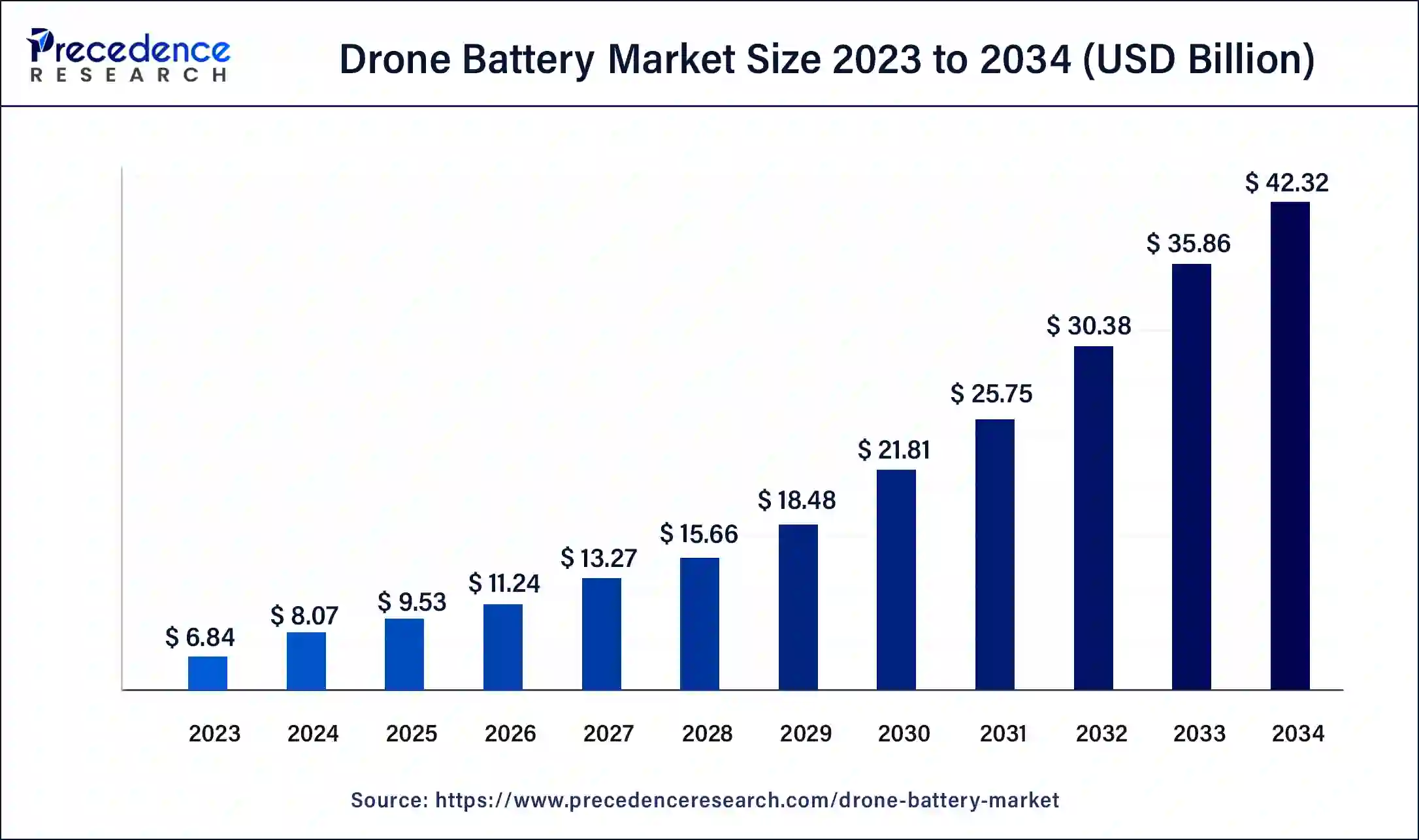
Rising investments in drone technology, combined with the push toward electrification and sustainability, are further strengthening market prospects. The surge in e-commerce delivery drones and military modernization programs remains a primary growth catalyst.
What’s Powering the Drone Battery Market?
The drone battery market is projected to witness robust growth driven by increasing UAV deployment across industries.
Lithium-based batteries continue to dominate due to superior energy density and lightweight characteristics.
North America leads the global market owing to strong defense spending and early adoption of drone technologies.
Asia-Pacific is emerging as the fastest-growing region fueled by manufacturing expansion and commercial drone usage.
Key players are focusing on innovation in battery efficiency, charging speed, and lifecycle performance
How Is Artificial Intelligence Enhancing Drone Battery Performance?
Artificial intelligence is playing an increasingly important role in optimizing drone battery systems. AI-driven battery management systems (BMS) are being deployed to monitor real-time performance, predict battery health, and optimize energy consumption during flight operations. These systems help improve flight duration, reduce downtime, and enhance overall operational efficiency.
Additionally, AI is enabling predictive maintenance by analyzing usage patterns and environmental conditions. This allows drone operators to proactively replace or service batteries before failure occurs, thereby reducing operational risks and improving fleet reliability.
What Are the Key Growth Drivers Accelerating the Market?
Rising Demand for Commercial Drones
The increasing use of drones in agriculture, delivery services, mapping, and inspection is significantly boosting demand for advanced battery systems capable of supporting longer flight durations.
Defense and Surveillance Expansion
Military applications, including reconnaissance and border surveillance, require high-endurance drones, thereby driving the need for durable and high-capacity batteries.
Advancements in Battery Technology
Continuous innovation in lithium-ion and emerging solid-state batteries is improving energy density, charging cycles, and safety features.
Growing Focus on Sustainability
Electrification trends and environmental concerns are encouraging the development of eco-friendly and recyclable battery solutions.
What Opportunities and Trends Are Shaping the Future of the Drone Battery Market?
Are Next-Generation Batteries Unlocking Longer Flight Times?
Yes, the development of solid-state and hydrogen fuel cell batteries is expected to significantly extend drone flight durations, opening new possibilities for long-range applications.
Can Swappable Battery Systems Transform Drone Operations?
Battery swapping technology is gaining traction, enabling rapid turnaround times and minimizing operational downtime, especially in logistics and delivery services.
Is Urban Air Mobility Creating New Demand?
The rise of urban air mobility (UAM) and drone taxis is expected to create a new segment of demand for high-capacity and ultra-reliable battery systems.
Drone Battery Market Dynamics
Driver
One of the major forces driving the drone battery market is the growing use of drones in surveillance, mapping, and monitoring activities across multiple sectors. Modern drones are equipped with advanced cameras and sensors, making them highly effective for public safety, border surveillance, and infrastructure monitoring.
This trend is especially strong in the defense sector, where drones play a critical role in mission operations. As a result, there is increasing demand for high-performance batteries that can support longer flight times and reliable operation.
At the same time, industries are looking for drones with extended endurance to improve efficiency and reduce downtime. This growing need for longer flight duration is pushing companies to invest heavily in developing more efficient and powerful drone batteries.
Restraint
Despite strong growth, the market faces challenges related to battery limitations and charging infrastructure. Most drones rely on batteries with limited energy density, which restricts flight time and requires frequent recharging.
This becomes even more problematic in remote or hard-to-reach areas where charging facilities are not readily available. The lack of a widespread and reliable charging network slows down operational efficiency and limits drone deployment in certain regions.
To overcome this, there is a strong need for lightweight batteries with higher energy capacity, along with improved charging infrastructure that can support continuous drone operations.
Opportunity
A key opportunity in the market lies in the development of solid-state and hybrid batteries. These next-generation batteries offer several advantages over traditional lithium-ion batteries, including:
Higher energy density
Longer flight endurance
Improved safety
Better overall performance
As technology continues to evolve, solid-state batteries are expected to transform the drone industry by enabling longer and more reliable operations. This innovation is attracting significant investment from major market players.
Technology Insights
Lithium-based batteries currently dominate the market, accounting for the largest share. Their popularity is driven by continuous advancements in lithium-sulfur and lithium-metal technologies, which enhance performance and efficiency.
Meanwhile, fuel cell batteries are expected to grow at the fastest rate in the coming years. They offer longer flight times, higher energy efficiency, and environmental benefits, making them a promising alternative to traditional batteries.
By Application
The military and defense sector holds the largest market share, as drones are widely used for surveillance, reconnaissance, and combat operations. These applications require highly reliable batteries with long endurance.
On the other hand, the commercial segment is growing the fastest. Industries such as logistics, agriculture, e-commerce, and infrastructure inspection are increasingly adopting drones to automate operations. This is driving demand for high-capacity batteries that can support longer missions.
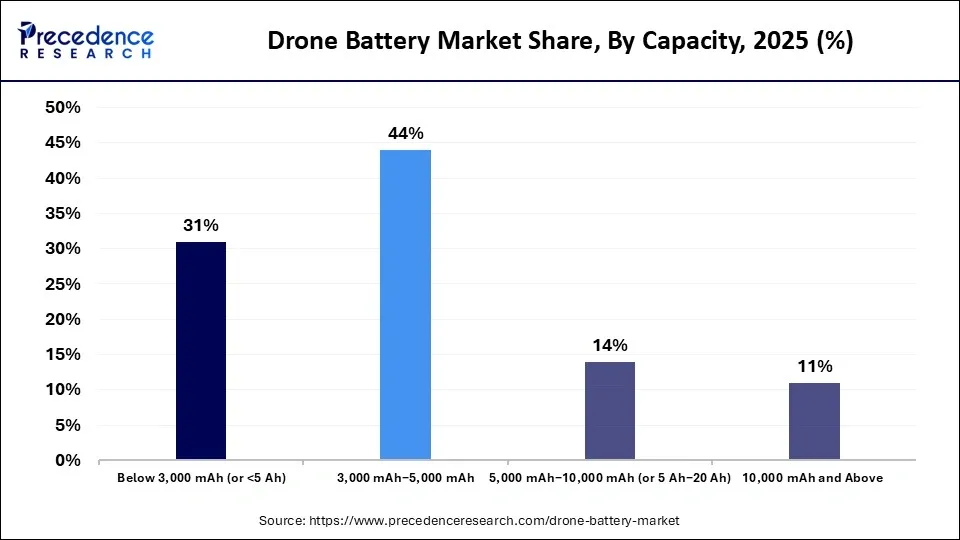
By Battery Capacity
Batteries in the 3,000 mAh to 5,000 mAh range dominate the market because they offer the right balance between weight, cost, and performance for most applications.
However, the 5,000 mAh to 10,000 mAh segment is growing rapidly. This reflects increasing demand for drones with longer flight times and higher payload capacity, especially in commercial use cases like delivery, surveying, and filmmaking.
By Drone Type
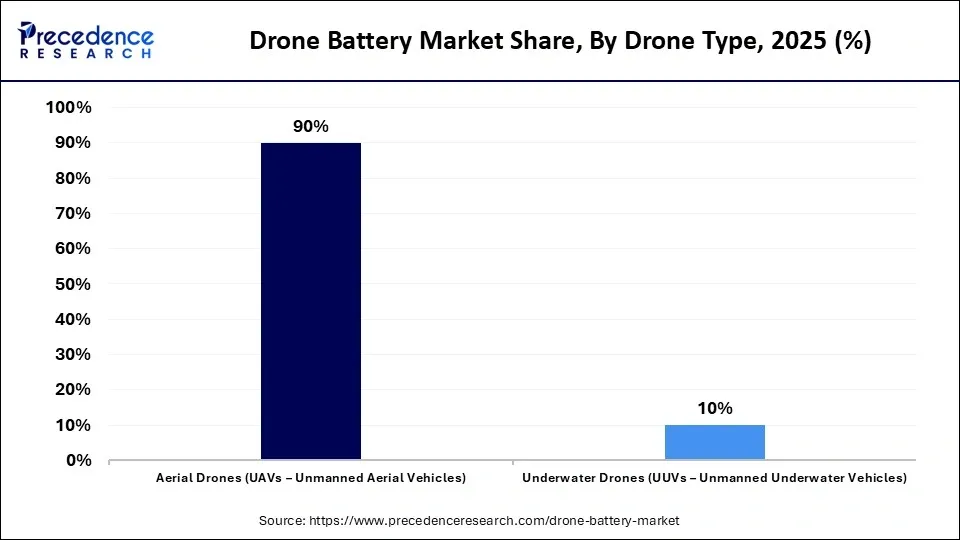
Aerial drones (UAVs) lead the market due to their widespread use across defense, commercial, and consumer applications.
In contrast, underwater drones (UUVs) are the fastest-growing segment. Their use in marine research, offshore inspections, and naval operations is increasing, creating demand for advanced batteries that can withstand extreme underwater conditions.
By Distribution Channel
OEM (Original Equipment Manufacturer) batteries dominate the market since most drones are sold with built-in batteries designed specifically for them. These batteries ensure compatibility, safety, and reliability.
However, the aftermarket segment is expanding quickly. As the number of drones in operation increases, so does the demand for replacement batteries and performance upgrades.
Regional Insights
North America leads the global market, driven by strong adoption in defense and commercial sectors, along with continuous technological advancements.
Asia Pacific is expected to grow the fastest due to increasing drone production and battery manufacturing in countries like China and India.
Europe is expanding steadily, supported by strict safety regulations and growing use of drones in industries like construction and environmental monitoring.
Latin America is emerging as a promising market, particularly in agriculture and mining.
Middle East & Africa are seeing rapid growth due to increased use of drones in surveillance, oil & gas, and smart city initiatives.
Drone Battery Market Companies
- Amperex Technology Limited
- Autel Robotics
- DJI
- LG Chem
- MaxAmps
- Panasonic
- Parrot
- Samsung SDI
- Tadiran Batteries
- Tattu (Shenzhen Grepow Battery Co., Ltd)
Segments Covered in the Report
By Technology
- Lithium-Based Batteries
- Lithium-Polymer (Li-Po)
- Lithium-Ion (Li-Ion)
- Lithium-Metal
- Lithium-Sulfur (Li-S)
- Solid-State Batteries
- Fuel Cell Batteries
- Hydrogen Fuel Cells
- Others
- Nickel-Based Batteries
- Nickel-Cadmium (Ni-Cd)
- Nickel-Metal Hydride (NiMH)
- Other Chemistries
- Sodium-ion
- Lead-Acid
By Application
- CCommercial Drones
- Agriculture (Spraying, Monitoring)
- Logistics & Delivery (Last-mile delivery, Cargo)
- Media & Entertainment (Filming, Photography)
- Surveying & Mapping
- Inspection & Monitoring (Infrastructure, Energy & Power, Construction)
- Military & Defense
- Intelligence, Surveillance, and Reconnaissance (ISR)
- Combat/Target Acquisition
- Search and Rescue (SAR)
- Battle Damage Management
- Government & Law Enforcement
- Public Safety & Security
- Border Patrol
- Traffic Monitoring
- Consumer / Recreational
- Hobbyist Drones
- Mini/Micro Quadcopters
By Capacity
- Below 3,000 mAh (or <5 Ah)
- 3,000 mAh−5,000 mAh
- 5,000 mAh−10,000 mAh (or 5 Ah−20 Ah)
- 10,000 mAh and Above
By Drone Type (UAV Configuration & Size)
- Aerial Drones (UAVs – Unmanned Aerial Vehicles)
- Multi-Rotor Drones
- Fixed-Wing Drones
- Hybrid VTOL (Vertical Take-Off & Landing)
- Single-Rotor Helicopter Drones
- Underwater Drones (UUVs – Unmanned Underwater Vehicles)
- AUVs (Autonomous Underwater Vehicles)
- ROVs (Remotely Operated Vehicles)
- Others (Specialized Drones)
By Point of Sale (Distribution Channel)
- OEM (Original Equipment Manufacturer)
- Aftermarket
By Geography
- North America
- Asia Pacific
- Europe
- LAMEA
Get Sample Link: https://www.precedenceresearch.com/sample/4995
Also Read : https://www.newsgazzete.com/thermal-jumpers-market/


