
Specialty Insurance Market Surges Toward USD 362.14 Billion by 2035
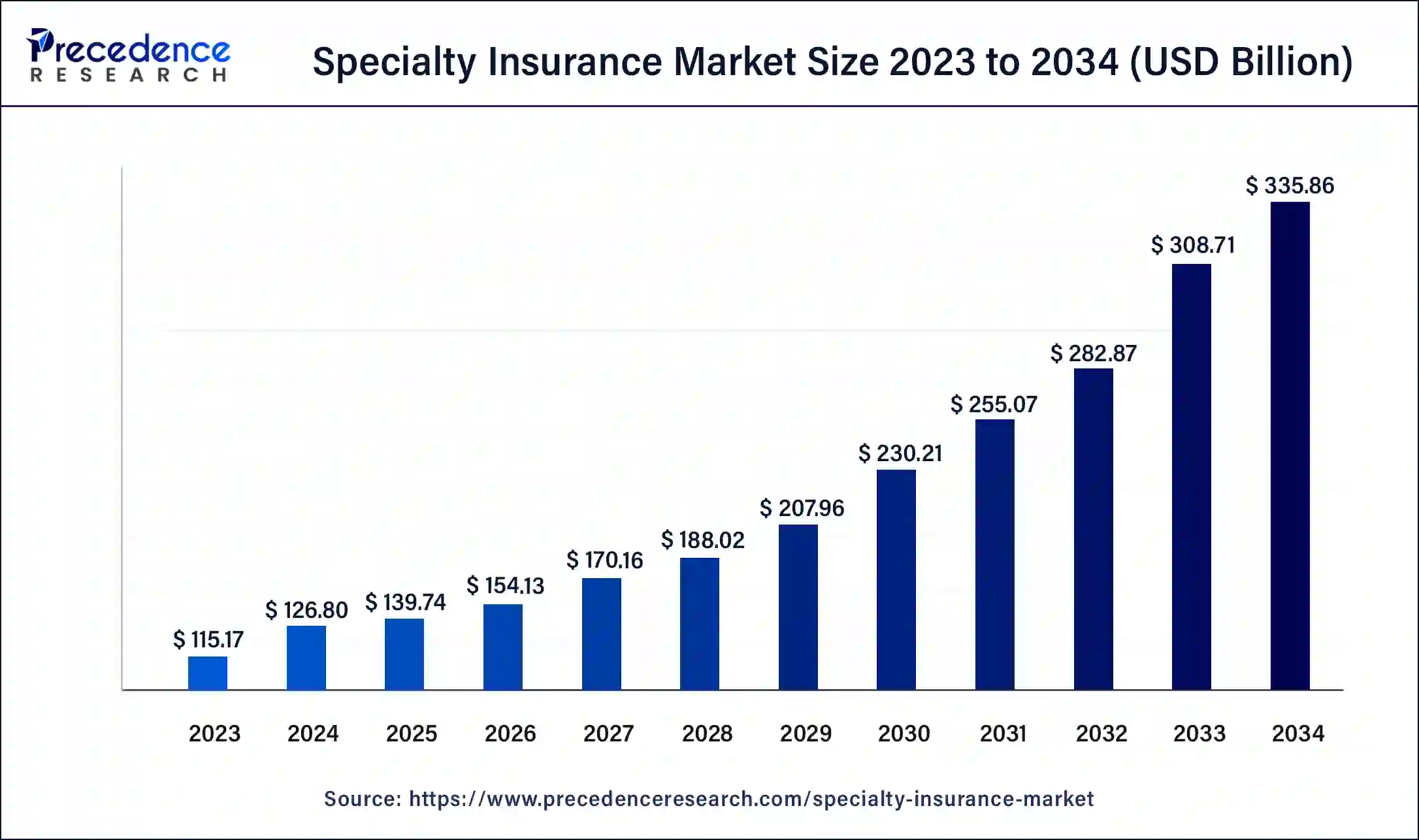
Specialty Insurance Market Size and Forecast 2025 to 2034

What is the Specialty Insurance Market Size in 2026?
The global specialty insurance market is witnessing strong momentum as businesses and individuals increasingly seek tailored coverage solutions for complex and evolving risks. According to recent analysis, the market is projected to grow significantly, reaching approximately USD 190 billion by 2034, expanding at a steady CAGR of around 8.5% from 2025 to 2034. Rising exposure to cyber threats, climate-related events, and niche liability risks are among the primary drivers fueling market expansion.
Why Is the Specialty Insurance Market Gaining Traction Globally?
The specialty insurance sector is rapidly gaining importance as traditional insurance products fail to adequately cover emerging and unconventional risks. Industries such as healthcare, aviation, marine, energy, and cybersecurity are increasingly demanding customized policies that address specific operational vulnerabilities.
Moreover, globalization and digital transformation have created new risk categories, compelling insurers to innovate and diversify their offerings. The growing awareness among enterprises regarding risk mitigation and financial protection is further accelerating the adoption of specialty insurance solutions.
Quick Insights
The specialty insurance market is expected to reach nearly USD 190 billion by 2034, growing at a CAGR of about 8.5% during the forecast period.
North America currently leads the global market due to advanced insurance infrastructure and high awareness among enterprises.
Europe follows closely, supported by stringent regulatory frameworks and rising demand for liability coverage.
The Asia Pacific region is anticipated to witness the fastest growth, driven by expanding industrialization and increasing risk exposure.
Cyber insurance and professional liability insurance are among the fastest-growing segments globally.
Leading players in the market are continuously investing in digital platforms and AI-driven underwriting solutions to enhance efficiency.
Insurance Type Market Trend
Cyber Insurance Rapid growth due to digital risks
Marine & Aviation Stable demand with global trade
Liability Insurance Increasing due to legal complexities
Energy Insurance Growth aligned with renewable sector
How Is Artificial Intelligence Transforming the Specialty Insurance Market?
Artificial intelligence is playing a transformative role in reshaping the specialty insurance landscape. Insurers are leveraging AI-driven analytics to enhance underwriting precision, enabling them to assess complex risks more accurately and price policies competitively. Predictive modeling tools are also helping insurers anticipate potential claims and reduce loss ratios.
Additionally, AI is streamlining claims processing and fraud detection. Automated systems can quickly analyze large datasets, identify anomalies, and expedite settlements, significantly improving customer experience. As risk environments become more dynamic, AI adoption is expected to become a cornerstone of specialty insurance innovation.
What Are the Key Growth Drivers in the Specialty Insurance Market?
The growth of the specialty insurance market is primarily driven by the increasing frequency and severity of unforeseen risks. Climate change has intensified natural disasters, while digitalization has amplified cyber threats, both requiring specialized coverage solutions.
Another major factor is the rising complexity of global business operations. Companies operating across multiple jurisdictions face diverse regulatory and liability challenges, necessitating customized insurance policies. Additionally, the surge in professional services and gig economy participation is boosting demand for professional liability insurance.
What Opportunities and Trends Are Shaping the Future of This Market?
Is Cyber Insurance Becoming the Backbone of Specialty Coverage?
Yes, cyber insurance is emerging as one of the most critical segments due to the exponential rise in cyberattacks and data breaches. Organizations are prioritizing cybersecurity investments alongside insurance coverage to mitigate financial losses.
Are Emerging Markets Unlocking New Growth Potential?
Absolutely. Developing economies in Asia Pacific, Latin America, and the Middle East are witnessing rapid industrialization and digital adoption, creating new opportunities for specialty insurers to expand their footprint.
Is Product Customization Driving Competitive Advantage?
Insurers are increasingly focusing on highly customized policies tailored to specific industries. This trend is helping companies differentiate themselves in a competitive marketplace.
Market Scope
| Report Coverage | Details |
| Market Size in 2025 | USD 139.74 Billion |
| Market Size in 2026 | USD 154.13 Billion |
| Market Size by 2035 | USD 362.14 Billion |
| Growth Rate from 2026 to 2035 | CAGR of 9.99% |
| Largest Market | Europe |
| Base Year | 2025 |
| Forecast Period | 2026 to 2035 |
| Segments Covered | Type, Distribution Channel, End User, and Region |
| Regions Covered | North America, Europe, Asia-Pacific, Latin America, and Middle East & Africa |
Market Dynamics
Driver
The fine arts and collectibles segment is a major driver of growth in the specialty insurance market. This is largely due to the rising value and diversity of art collections and high-value collectibles worldwide. As the global art market expands, collectors, galleries, and institutions increasingly seek customized insurance solutions to protect their assets from risks such as theft, damage, or loss.
Unlike standard insurance policies, fine art and collectible items require highly specialized coverage because of their uniqueness, rarity, and often fluctuating market value. Specialty insurers address these needs by offering tailored policies that cover a broad spectrum of risks, including accidental damage during transportation, restoration processes, exhibition handling, and theft.
In addition, the growing number of private collectors, galleries, and cross-border art transactions has further fueled demand for such insurance. This niche segment plays a crucial role in driving the broader specialty insurance market by addressing highly specific and valuable risk exposures.
Restraint
One of the key challenges in the specialty insurance market is its inherently limited market size. Since specialty insurance focuses on unique and niche risks, its target audience is relatively small compared to traditional insurance markets.
This limited customer base makes it difficult for insurers to achieve economies of scale, often resulting in higher operational costs and less competitive pricing. Additionally, intense competition among providers for a small pool of clients can further compress profit margins.
While specialty insurance serves an essential role in managing non-standard risks, its niche nature can restrict scalability and long-term growth potential.
Opportunity
The agricultural sector presents a strong growth opportunity for specialty insurers. With increasing challenges such as climate change, unpredictable weather, and evolving global supply chains, farmers and agribusinesses are actively seeking tailored insurance solutions.
Specialty insurers can offer products such as crop insurance, livestock coverage, and weather-based risk protection. The rise of advanced farming technologies—like precision agriculture and drone monitoring—also introduces new types of risks that require specialized coverage.
Moreover, the growing adoption of sustainable and organic farming practices opens the door for environmentally aligned insurance products. Altogether, the agricultural sector provides a dynamic and expanding space for innovation in specialty insurance.
Technological Advancements
Technological innovation is transforming the specialty insurance landscape. Tools such as artificial intelligence (AI), machine learning (ML), and natural language processing (NLP) are improving efficiency and decision-making across the industry.
NLP helps extract critical information—such as claim details and policyholder data—from unstructured sources like emails and documents. AI enhances risk assessment, underwriting, and claims processing, reducing both time and operational costs. It also integrates external data sources, such as health metrics and social media, to improve accuracy.
Machine learning enables insurers to analyze large datasets, identify high-value customers, and detect fraudulent claims more effectively. These technologies are helping insurers deliver faster, smarter, and more personalized services, strengthening their competitive edge.
Segment Insights
Type Insights
The Marine, Aviation, and Transport (MAT) insurance segment accounted for approximately 25% of market revenue in 2025. This segment is vital due to its role in covering complex, high-value risks associated with global trade and logistics, including cargo, vessels, and aircraft.
As international trade continues to grow and the value of goods in transit increases, demand for MAT insurance remains strong, making it a cornerstone of the specialty insurance market.
Meanwhile, the “others” segment is expected to grow at a notable CAGR of 11.2% over the forecast period. This category includes niche insurance types such as pet insurance, event cancellation coverage, and emerging areas like space tourism. Its flexibility and adaptability to evolving risks make it a key growth driver.
Distribution Channel Insights
Brokers dominated the market in 2025, accounting for around 60% of total share. Their expertise in matching clients with suitable insurers and navigating complex policies makes them a preferred choice for specialty insurance buyers.
Brokers provide access to a wide range of customized solutions and help clients understand intricate coverage requirements, building trust and ensuring optimal protection.
However, the non-broker channel is expected to grow at the fastest rate. Direct engagement with insurers allows for more tailored solutions, faster decision-making, and cost efficiencies. Many organizations now rely on in-house risk management teams, further boosting this channel’s growth.
End-User Insights
The business segment held the largest share of 59% in 2025. Businesses face a wide array of complex risks, including cyber threats, supply chain disruptions, and regulatory challenges. Specialty insurance helps them manage these risks effectively while ensuring operational continuity.
On the other hand, the individual segment is projected to grow the fastest. Increasing awareness of personalized risk coverage—especially among high-net-worth individuals, collectors, and niche lifestyle users—is driving demand. Coverage for areas such as cyber security, fine art, and specialized activities is becoming increasingly popular.
Regional Insights
Europe
Europe led the global specialty insurance market with a 39% revenue share in 2025. The market is expected to grow from USD 54.50 billion in 2025 to USD 141.23 billion by 2035, at a CAGR of 10.01%.
This strong position is supported by a diverse industrial base, a well-established art market, and strict regulatory requirements. Additionally, Europe’s focus on sustainability and renewable energy creates demand for specialized insurance solutions.
Germany
Germany’s market is expanding due to high demand for coverage in areas such as marine, engineering, and art insurance. The country’s strict regulatory framework also drives innovation in compliance-focused insurance solutions. Embedded insurance models are gaining traction, integrating coverage directly into digital platforms.
Asia-Pacific
Asia-Pacific is expected to witness the fastest growth in the specialty insurance market. Rapid economic development, rising middle-class wealth, and increasing asset ownership are key drivers.
Businesses in the region are also expanding globally, increasing demand for protection against international and complex risks. Additionally, the growth of insurtech and supportive regulations are accelerating market expansion.
Japan
Japan’s market is evolving through digital transformation, with increased adoption of AI-driven underwriting and customer engagement tools. Growth in renewable energy projects and rising cyber risks are further boosting demand for specialized insurance products.
Australia (Health Insurance Context)
Data from mid-2024 highlights regional variations in private health insurance coverage across Australia. Approximately 44.8% of the population had hospital treatment coverage.
States like Western Australia and the Australian Capital Territory show higher participation rates, while regions such as the Northern Territory lag behind. These differences are influenced by income levels, demographics, and reliance on public healthcare systems.
Specialty Insurance Market Companies
- Chubb Limited
- Allianz SE
- Munich Re
Segments Covered in the Report
By Type
- Political Risk and Credit Insurance
- Entertainment Insurance
- Art Insurance
- Livestock and Aquaculture Insurance
- Marine, Aviation and Transport (MAT) Insurance
- Others
By Distribution Channel
- Brokers
- Non-brokers
By End User
- Business
- Individuals
By Geography
- North America
- Europe
- Asia-Pacific
- Latin America
- Middle East and Africa
Get Sample Link: https://www.precedenceresearch.com/sample/3519
Also Read : https://www.newsgazzete.com/medical-device-outsourcing-market/

