
Real-time Spectrum Analysis Market Surges Toward USD 1,081.74 Billion by 2035

What is the Real-time Spectrum Analysis Market
Size in 2026?
The global real-time spectrum analysis market is witnessing robust expansion, fueled by increasing demand for advanced wireless communication monitoring, rapid technological advancements, and the proliferation of connected devices. According to Precedence Research, the market is projected to grow from USD 540 million in 2024 to approximately USD 1.2 billion by 2034, registering a CAGR of 8.7% during the forecast period. Rising spectrum congestion, expansion of 5G infrastructure, and growing defense surveillance requirements are among the key factors propelling market growth.
What’s Driving the Market?
The market was valued at USD 540 million in 2024 and is expected to surpass USD 1.2 billion by 2034.
North America continues to dominate the market due to strong defense and telecom investments.
Asia Pacific is anticipated to grow at the fastest rate, driven by rapid 5G deployment.
Portable spectrum analyzers are gaining traction due to field-use flexibility.
Leading companies include Keysight Technologies, Rohde & Schwarz, Tektronix, Anritsu Corporation, and National Instruments.
How Is AI Transforming Real-Time Spectrum Analysis?
Artificial Intelligence is playing an increasingly pivotal role in the evolution of real-time spectrum analysis. AI-driven algorithms are enhancing signal detection accuracy, enabling automated classification of complex waveforms, and significantly reducing human intervention in spectrum monitoring. This is particularly beneficial in defense and telecommunications where real-time decision-making is critical.
Additionally, machine learning models are being integrated into spectrum analyzers to predict interference patterns and optimize bandwidth allocation. These capabilities are helping telecom providers improve network efficiency and minimize downtime, while defense agencies benefit from faster threat detection and response mechanisms.
What Are the Key Growth Factors Shaping the Market?
The growing complexity of wireless ecosystems is a major growth catalyst. With the expansion of IoT, 5G networks, and satellite communications, the need for real-time monitoring tools has intensified. Spectrum analyzers capable of capturing transient signals and identifying interference in real time are becoming essential.
Another critical factor is the rising demand from defense and aerospace sectors. Governments worldwide are investing heavily in electronic warfare systems and surveillance technologies, where real-time spectrum analysis plays a vital role. Additionally, regulatory requirements for spectrum management are pushing telecom operators to adopt advanced monitoring solutions.
What Opportunities and Trends Are Emerging in the Market?
How Is 5G Deployment Creating New Opportunities?
The global rollout of 5G networks is generating significant demand for advanced spectrum analysis tools. These tools are essential for ensuring signal integrity, minimizing interference, and maintaining network performance in dense urban environments.
Why Are Portable Devices Gaining Popularity?
Portable and handheld spectrum analyzers are becoming increasingly popular due to their convenience and field applicability. Engineers and technicians prefer lightweight devices that offer high performance without the need for bulky setups.
Is There Growing Demand in Emerging Economies?
Yes, emerging economies in Asia Pacific and Latin America are investing heavily in telecom infrastructure, creating substantial growth opportunities for market players.
Market Scope
| Report Highlights | Details |
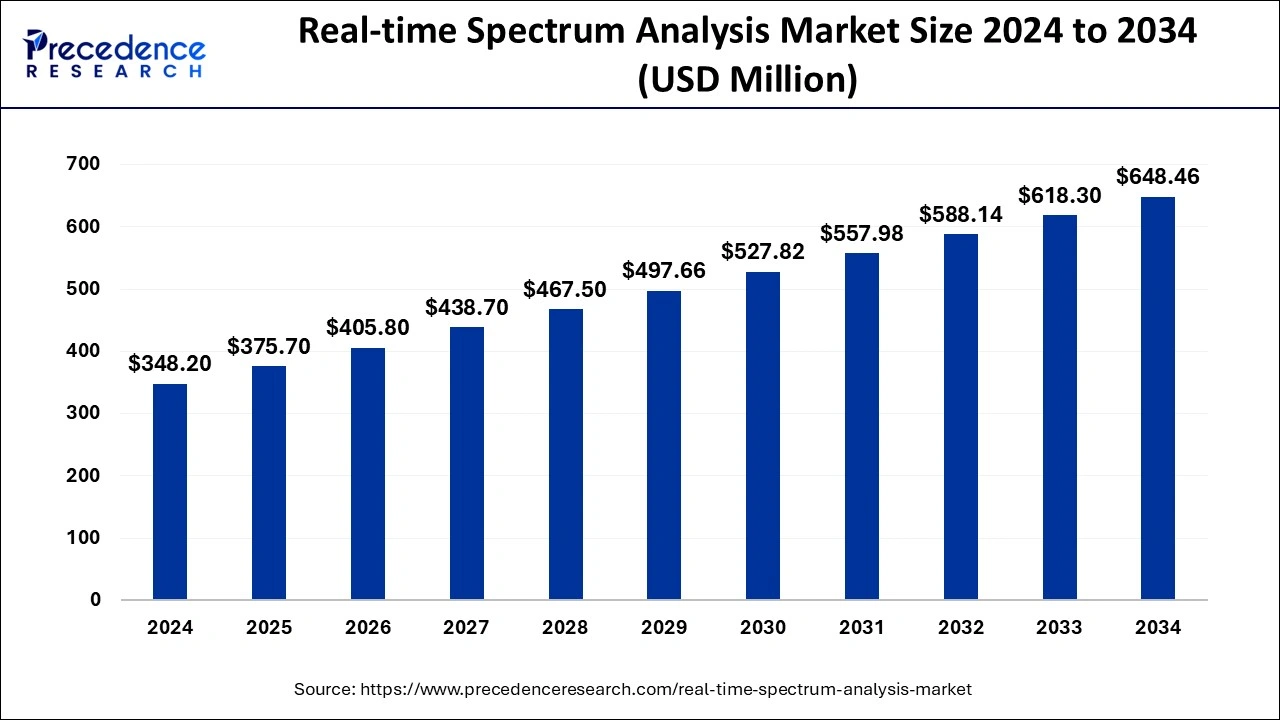
| Market Size in 2025 | USD 375.70 Million |
| Market Size in 2026 | USD 405.80 Million |
| Market Size by 2035 | USD 678.63 Million |
| Growth Rate from 2026 to 2035 | CAGR of 6.09% |
| Largest Market | North America |
| Base Year | 2025 |
| Forecast Period | 2026 to 2035 |
| Segments Covered | Product Type, Application Type, Region Type, and region |
| Regions Covered | North America, Europe, Asia-Pacific, Latin America, and Middle East & Africa |
Market Dynamics
Drivers: Rising Demand for Wireless Networks
The real-time spectrum analysis (RTSA) market is being shaped by several transformative factors that are redefining how industries monitor and manage radio frequency (RF) environments. One of the primary drivers is the rapid expansion of wireless communication technologies such as 5G, Wi-Fi 6/6E, and the Internet of Things (IoT). These advancements have made RF environments increasingly complex and congested, creating a strong need for real-time tools that enable accurate signal detection, interference analysis, and spectrum compliance.
Another key growth driver is the increasing adoption of advanced electronic warfare and defense systems worldwide. Governments and military organizations rely heavily on RTSA solutions for secure communications, radar testing, and threat detection. At the same time, telecom operators and broadcasters are integrating these tools to continuously monitor spectrum usage and diagnose network issues, driven by the exponential growth in connected devices.
Technological innovation is also accelerating market expansion. Developments such as FPGA-based architectures, AI-driven analytics, and cloud-enabled spectrum monitoring are enabling faster data processing, automated anomaly detection, and remote diagnostics. As spectrum becomes an increasingly valuable and limited resource, industries are recognizing the importance of maintaining spectrum clarity, regulatory compliance, and optimal network performance—making RTSA tools essential across multiple applications.
Restraints: High Cost of Analyzers
Despite its strong growth potential, the RTSA market faces several challenges that may hinder broader adoption. One of the most significant barriers is the high cost associated with advanced spectrum analyzers. Features such as high bandwidth, rapid sampling rates, and AI integration make these systems expensive, limiting accessibility for small and medium-sized enterprises (SMEs) with constrained budgets.
In addition to cost concerns, the complexity of RTSA systems presents another obstacle. Operating and interpreting data from these tools often requires specialized expertise, leading to a talent gap in many organizations. Integration with legacy systems can further complicate deployment, especially in the absence of standardized protocols.
Data security and privacy concerns also come into play, particularly with the increasing use of cloud-based monitoring solutions. Moreover, the large volumes of data generated by RTSA systems can strain storage and processing capabilities. Addressing these challenges will be critical to unlocking the full potential of RTSA adoption across industries.
Opportunities: Integration of AI and Machine Learning
The RTSA market is poised for significant growth, driven by the increasing complexity of RF environments and continuous advancements in wireless technologies. One of the most promising opportunities lies in the integration of artificial intelligence (AI) and machine learning (ML). These technologies enable intelligent spectrum monitoring, automated interference detection, and predictive analytics, helping organizations improve efficiency while reducing manual intervention and downtime.
Another emerging opportunity is the rise of portable and cloud-connected RTSA solutions. These systems support remote diagnostics, real-time collaboration, and on-the-go spectrum monitoring, making them highly valuable across industries. As 5G, satellite communications, and IoT ecosystems expand, sectors such as telecommunications, aerospace, defense, and broadcasting are increasingly investing in next-generation RF monitoring tools.
Additionally, growing interest in spectrum sharing and regulatory compliance is creating new use cases, particularly in public safety and government applications. Advancements in software-defined radio (SDR) and cognitive radio technologies further expand the potential for RTSA deployment. As digital transformation accelerates and spectrum congestion intensifies, RTSA solutions are expected to become a critical component of future wireless infrastructure.
Segment Insights
The global RTSA market is segmented by product type and application. Product categories include handheld, benchtop, and portable analyzers, while applications span healthcare, automotive, energy and power, aerospace and defense, IT and telecommunications, semiconductor and electronics, industrial sectors, and others.
Type Insights
Benchtop analyzers currently dominate the market due to their widespread use in commercial and laboratory settings, along with their advanced capabilities and broad product availability. Portable analyzers represent the second-largest segment and are experiencing strong growth, driven by their ease of use, flexibility, and relatively lower cost.
Application Insights
The IT and telecommunications sector accounts for the largest share of the RTSA market, primarily due to the growing need for efficient spectrum management amid increasing network complexity. Meanwhile, the automotive sector is expected to witness the fastest growth during the forecast period, fueled by advancements in connected and autonomous vehicle technologies.
Technological Insights
Digital real-time spectrum analyzers dominate the market due to their superior speed, bandwidth, and dynamic range. These systems utilize high-speed digitizers combined with FPGA-based processing to capture and analyze even the shortest transient signals in real time. Their precision and reliability make them indispensable in applications where timing and accuracy are critical, such as telecommunications, aerospace, and electronics manufacturing.
At the same time, portable RTSA solutions are emerging as the fastest-growing segment. Their compact design, combined with cloud connectivity, enables real-time monitoring, interference detection, and remote diagnostics. Many modern portable analyzers now incorporate AI-driven features such as automatic signal classification and anomaly detection, making them highly effective for applications like 5G deployment, smart city development, and mission-critical communications.
End-User Insights
The telecommunications sector holds the largest share of the RTSA market, driven by the rapid expansion of 5G networks, the growing IoT ecosystem, and the increasing need to manage spectrum congestion and interference. Telecom operators rely extensively on RTSA tools for optimizing network performance and ensuring seamless connectivity.
In contrast, the aerospace and defense sector is among the fastest-growing segments. Increasing investments in electronic warfare, secure communications, and radar systems are driving demand for advanced spectrum analysis tools. RTSA solutions play a crucial role in signal intelligence (SIGINT), threat detection, and spectrum surveillance, enhancing situational awareness and operational efficiency in defense applications.
Regional Insights
United States Market Trends (2026–2035)
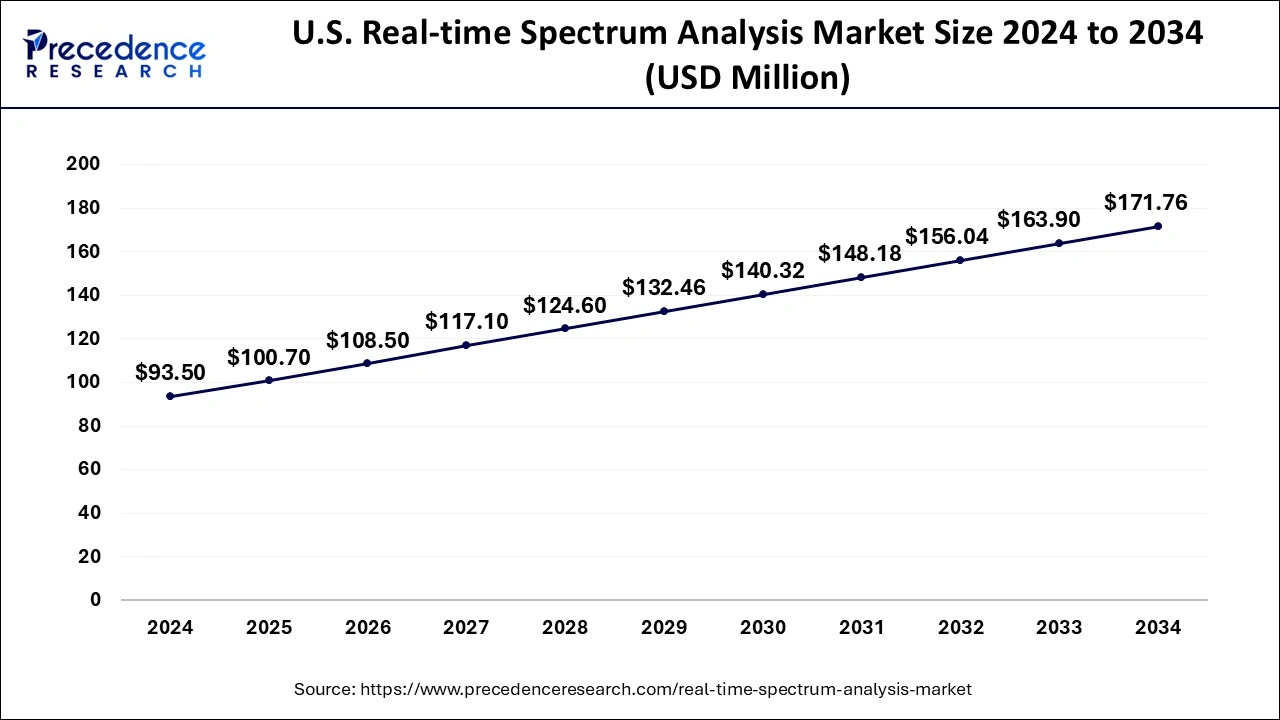
The United States represents a key market for RTSA, supported by strong investments in defense, telecommunications, and advanced technologies. The market is projected to grow from USD 100.70 million in 2025 to approximately USD 179.62 million by 2035, registering a CAGR of 5.96%.
Growth in the U.S. is driven by ongoing 5G deployment, expansion of telecom infrastructure, and increased focus on national security and border protection. The presence of leading technology companies and robust government initiatives further supports innovation and adoption of advanced spectrum analysis solutions.
North America Outlook
North America is expected to remain a leading region in the RTSA market, driven by strong R&D investments, early adoption of advanced communication technologies, and a well-established regulatory framework. The region’s leadership in 5G infrastructure, AI integration, and aerospace and defense modernization continues to fuel demand for high-performance spectrum analyzers.
Government initiatives aimed at enhancing national security and improving wireless communication efficiency are further accelerating RTSA adoption across sectors such as defense, telecommunications, and broadcasting. Additionally, widespread adoption of IoT and cloud-based RF monitoring solutions is supporting the development of next-generation RTSA technologies.
Real-time Spectrum Analysis MarketCompanies
- ThinkRF Corp
- Rohde & Schwarz GmbH & Co.
- Keysight Technologies
- Signal Hound
- Aaronia AG
- Tektronix
- Anritsu Corporation
- Standford Research Systems
- Micronix Corporation
Segments Covered in the Report
By Product
- Handheld Analyzer
- Benchtop Analyzer
- Portable Analyzer
By Application
- Healthcare
- Automotive
- Energy & Power
- Aerospace & Defense
- IT & Telecommunication
- Semiconductor & Electronics
- Industrial
- Others
By Region
- North America
- Europe
- Asia-Pacific
- Latin America
- Middle East & Africa
Get Sample Link: https://www.precedenceresearch.com/sample/1172
Also Read : https://www.newsgazzete.com/cnc-milling-machines-market/

