
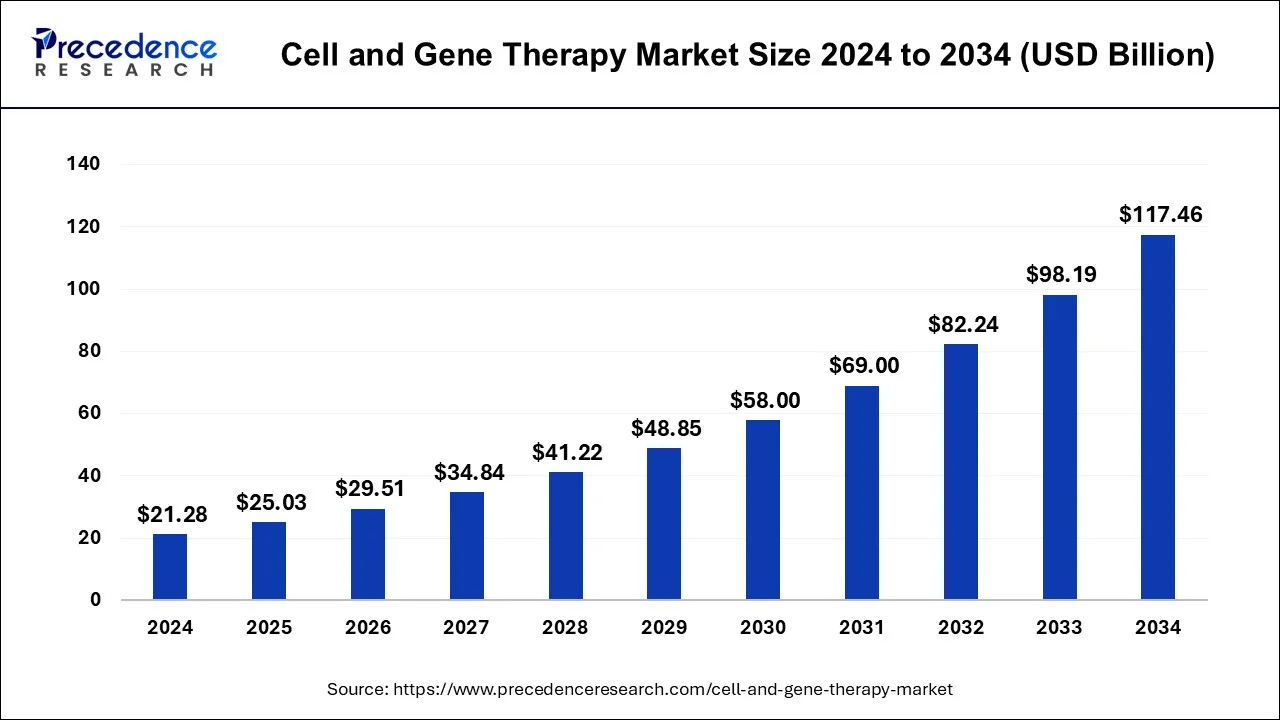
Valued at USD 8.94 billion in 2025, the global cell and gene therapy market is anticipated to reach around USD 47.18 billion by 2035, rising from USD 10.44 billion in 2026 at a compound annual growth rate (CAGR) of 18.1% between 2026 and 2035.
Understanding Cell and Gene Therapy
Cell and gene therapies represent two closely related but distinct approaches to treating diseases.
What is Cell Therapy?
Cell therapy involves the transplantation, replacement, or modification of living cells to restore normal biological function. The therapy may use a patient’s own cells (autologous therapy) or donor cells (allogeneic therapy).
Common forms of cell therapy include:
- Stem cell therapy
- CAR-T cell therapy
- Natural killer (NK) cell therapy
- Dendritic cell therapy
- Regenerative medicine applications
What is Gene Therapy?
Gene therapy involves introducing, removing, or altering genetic material within a patient’s cells to treat or prevent disease.
Gene therapy approaches include:
- Gene replacement
- Gene silencing
- Gene addition
- Gene editing
- Gene correction
Advanced technologies such as CRISPR-Cas9, TALENs, and Zinc Finger Nucleases are enabling highly precise genetic modifications, creating opportunities to treat rare inherited disorders and chronic diseases.
Cell and Gene Therapy Market Overview
The cell and gene therapy industry has evolved from a niche research area into one of the fastest-growing sectors within biotechnology and healthcare. Increasing success in clinical trials and regulatory approvals has strengthened confidence among investors and healthcare providers.
Several factors are contributing to market expansion:
- Rising prevalence of cancer and rare genetic disorders
- Growing investments in biotechnology research
- Increasing regulatory support
- Expansion of precision medicine initiatives
- Advancements in manufacturing technologies
- Rising demand for curative therapies
The industry is transitioning from experimental treatments to commercially viable healthcare solutions capable of delivering long-term therapeutic benefits.
Get this report to explore global market size, share, CAGR, and trends, featuring detailed segmental analysis and an insightful competitive landscape overview: https://www.precedenceresearch.com/sample/2445
Technological Advancements in Gene Editing and Cell Engineering
Technological innovation is a major force driving the growth of the cell and gene therapy market. Modern gene-editing tools and cell-engineering techniques have significantly improved the precision, safety, and effectiveness of therapeutic interventions. Researchers can now modify cells and genes with unprecedented accuracy, enabling the development of treatments for complex diseases such as cancer, genetic disorders, and autoimmune conditions. Advances in synthetic biology, genome sequencing, and cellular engineering are accelerating the creation of personalized therapies tailored to individual patient needs. These innovations are also reducing development timelines and improving clinical outcomes, making cell and gene therapies increasingly viable for commercial adoption.
Impact of Precision Medicine on Market Expansion
Precision medicine is transforming healthcare by shifting treatment approaches from generalized therapies to individualized solutions. Cell and gene therapies play a central role in this transformation because they target the unique genetic and molecular characteristics of each patient. By analyzing genetic profiles, healthcare providers can develop customized treatment strategies that improve efficacy while minimizing adverse effects. The growing demand for personalized healthcare is encouraging pharmaceutical companies and biotechnology firms to invest heavily in advanced therapeutic platforms. As genetic testing becomes more accessible and affordable, the integration of precision medicine is expected to significantly expand the adoption of cell and gene therapies worldwide.
Role of CRISPR and Advanced Genetic Technologies
CRISPR technology has emerged as one of the most revolutionary developments in genetic engineering. It allows scientists to precisely edit DNA sequences, enabling the correction of disease-causing mutations at their source. Beyond CRISPR, advanced technologies such as base editing, prime editing, and zinc finger nucleases are expanding the possibilities for gene modification. These tools offer greater precision and reduced risk of unintended genetic changes, improving the safety profile of gene therapies. Their ability to address inherited disorders, rare diseases, and certain cancers has attracted substantial investment from both public and private sectors, accelerating innovation across the market.
Key Factors Driving Cell and Gene Therapy Market Growth
Growing Burden of Cancer
Cancer remains one of the leading causes of death worldwide. Traditional treatments such as chemotherapy and radiation often have limitations, including toxicity and relapse risks.
Cell therapies, particularly CAR-T therapies, have demonstrated remarkable effectiveness in treating various blood cancers by enabling the immune system to directly target cancer cells.
As cancer incidence rises globally, demand for advanced immunotherapies continues to increase.
Increasing Prevalence of Rare Genetic Disorders
More than 7,000 rare diseases have been identified globally, many of which are caused by genetic mutations.
Conventional treatments often provide only symptom management. Gene therapies offer the possibility of correcting the underlying genetic defect, making them particularly valuable for rare disease treatment.
Growing awareness and improved genetic testing capabilities are accelerating diagnosis rates and expanding the patient population eligible for these therapies.
Applications of Cell and Gene Therapy Market
- Cancer treatment remains the largest application segment.
- Cell therapies enable immune cells to identify and destroy cancer cells more effectively than traditional treatments.
- Gene therapies are also being developed to improve immune responses and target tumor-specific mutations.
Read Also: Corporate Wellness Market
Case Study CAR-T Therapy Revolutionizing Blood Cancer Treatment
One of the most notable success stories in cell therapy is CAR-T treatment for blood cancers.
In this process:
- A patient’s T-cells are collected.
- The cells are genetically modified.
- Modified cells are multiplied in a laboratory.
- Cells are infused back into the patient.
The engineered T-cells recognize and destroy cancer cells more effectively than natural immune responses.
Patients with treatment-resistant leukemia and lymphoma have achieved remarkable remission rates, demonstrating the transformative potential of cell therapy.
This success has encouraged researchers to develop similar therapies for solid tumors and autoimmune diseases.
Regional Analysis
North America leads the global market due to:
- Strong biotechnology ecosystem
- High healthcare expenditure
- Advanced research infrastructure
- Significant venture capital investments
- Supportive regulatory pathways
The United States remains the world’s largest market for cell and gene therapies.
Europe maintains a strong position through:
- Extensive clinical research
- Government funding programs
- Growing adoption of precision medicine
- Expanding biotechnology sector
Germany, the United Kingdom, and France are major contributors.
Asia-Pacific is projected to witness the fastest growth.
Growth factors include:
- Expanding healthcare infrastructure
- Rising biotechnology investments
- Growing patient population
- Government support for innovation
- Increasing clinical trial activity
China, Japan, South Korea, and India are emerging as major market hubs.
The region is experiencing gradual growth due to improving healthcare access and increasing awareness of advanced therapeutic options.
Healthcare modernization initiatives and growing investment in biotechnology are expected to support steady market development.
Future Outlook
The future of the cell and gene therapy market is exceptionally promising. Advances in gene editing, synthetic biology, regenerative medicine, artificial intelligence, and manufacturing technologies are expected to drive the next wave of innovation. As production processes become more efficient and costs decline, these therapies will become accessible to larger patient populations worldwide.
Over the next decade, cell and gene therapies are likely to move beyond rare diseases and oncology into mainstream treatment areas including cardiovascular disease, neurological disorders, autoimmune conditions, and regenerative medicine. Continued collaboration among biotechnology companies, healthcare providers, regulators, and investors will be critical in overcoming manufacturing and affordability challenges.
You can place an order or ask any questions, please feel free to contact us at sales@precedenceresearch.com |+1 804 441 8440


