
Plastic Waste Management Market Accelerates Toward USD 67.69 Billion Valuation by 2035

What is the Plastic Waste Management Market Size in 2026?
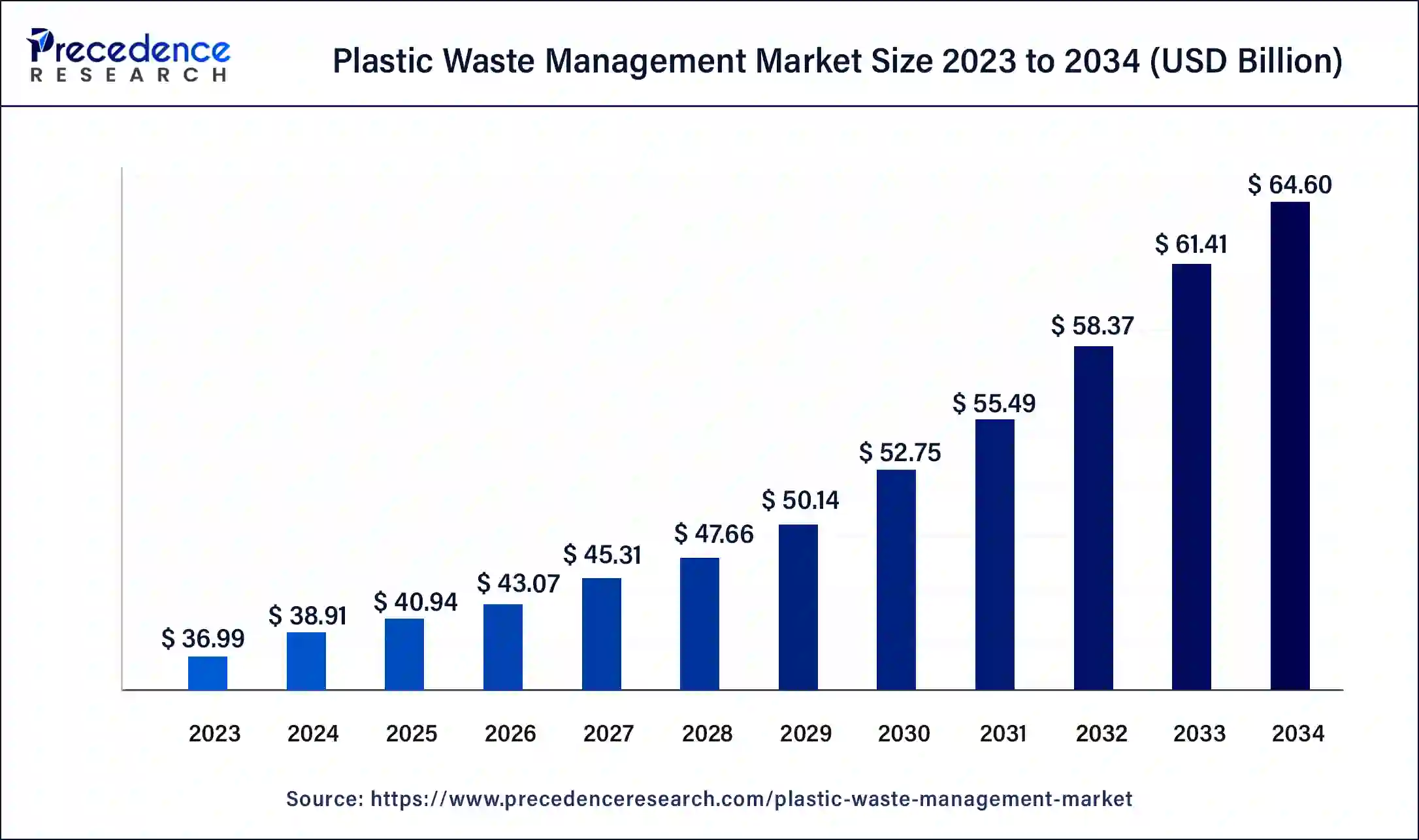
The global plastic waste management market is undergoing a structural transformation, driven by intensifying environmental regulations, rapid urbanization, and the urgent need for circular economy solutions. According to Precedence Research, the market was valued at USD 36.99 billion in 2023 and is projected to reach USD 57.39 billion by 2032, expanding at a CAGR of 5% during the forecast period.
Growing concerns over plastic pollution, coupled with government-backed recycling mandates and corporate sustainability commitments, are accelerating investments in advanced waste collection, recycling, and recovery technologies worldwide.
What’s Driving the Plastic Waste Management Market?
The plastic waste management market was valued at USD 36.99 billion in 2023 and is expected to reach USD 57.39 billion by 2032, reflecting steady global demand growth.
Asia Pacific stands as the leading regional market, driven by rapid industrialization and population expansion.
Recycling and circular economy initiatives are emerging as the most influential trends shaping industry transformation.
Leading players such as Veolia Environment, SUEZ, Waste Management Inc., and Republic Services dominate the competitive landscape.
Government regulations and sustainability mandates remain the primary catalysts accelerating market expansion.
How is the Plastic Waste Management Market Structured Today?
The market encompasses a broad ecosystem of services including collection, recycling, incineration, and landfill management, all aimed at minimizing environmental damage caused by plastic waste.
The steady rise in revenue reflects increased investments in recycling infrastructure and the growing adoption of waste-to-energy technologies globally.
How is Artificial Intelligence Transforming Plastic Waste Management?
Artificial Intelligence is rapidly becoming a cornerstone in modern waste management systems. AI-powered sorting technologies, using computer vision and deep learning, are significantly improving the efficiency and accuracy of plastic segregation. Advanced models can identify and classify different polymer types with high precision, reducing contamination and improving recycling output quality.
Moreover, AI-driven predictive analytics is enabling municipalities and waste management companies to optimize collection routes, reduce operational costs, and forecast waste generation patterns. These innovations are not only enhancing efficiency but also supporting the transition toward a more scalable and economically viable circular plastic economy.
Market Scope
| Report Coverage | Details |
| Market Size in 2025 | USD 40.94 Billion |
| Market Size in 2026 | USD 43.07 Billion |
| Market Size by 2035 | USD 67.69 Billion |
| Growth Rate from 2025 to 2034 | CAGR of 5.16% |
| Base Year | 2025 |
| Forecast Period | 2026 to 2035 |
| Segments Covered | Service, Polymer, Source, End Use, and Region |
| Regions Covered | Asia Pacific, North America, Europe, Latin America, Middle East and Africa |
What Are the Key Growth Drivers Shaping the Market?
1. Why are environmental concerns accelerating demand?
The alarming rise in plastic pollution and its long-term ecological impact is compelling governments and organizations to adopt sustainable waste management practices.
2. How are regulations influencing market expansion?
Stringent policies such as plastic bans, recycling mandates, and extended producer responsibility (EPR) programs are pushing industries toward responsible waste handling.
3. What role does urbanization play?
Rapid urban growth is significantly increasing plastic consumption, thereby driving the demand for efficient waste management infrastructure.
4. Why is the circular economy gaining traction?
Companies are increasingly focusing on recycling and reusing plastic materials to reduce reliance on virgin resources, creating long-term growth opportunities.
What Opportunities and Trends Are Emerging in the Market?
Is chemical recycling the next big breakthrough?
Yes, chemical recycling technologies are gaining traction as they enable the conversion of plastic waste into high-quality raw materials, supporting circular economy goals.
Can waste-to-energy solutions redefine profitability?
Absolutely. Converting plastic waste into energy is emerging as a viable revenue stream, particularly in regions with limited recycling infrastructure.
Are sustainable packaging innovations creating new demand?
Yes, the shift toward recyclable and biodegradable packaging is driving demand for advanced waste processing technologies.
Plastic Waste Management Market Insights (Simplified & Humanized)
Service Insights
In 2025, the recycling segment led the plastic waste management market. This growth is mainly driven by strict government regulations and significant investments in recycling infrastructure. Recycled plastics are widely used across multiple industries, which further supports this segment’s dominance.
On the other hand, the collection segment is expected to grow the fastest in the coming years. Waste collection remains both the most essential and the most challenging part of the system. Key market players are increasingly focusing on improving collection services across residential, commercial, and industrial sectors.
Polymer Type Insights
Polypropylene emerged as the dominant polymer type in 2025. Its popularity comes from being cost-effective, easily available, and adaptable to different manufacturing processes, making it suitable for both household and industrial applications.
Meanwhile, low-density polyethylene (LDPE) is projected to grow rapidly, with a CAGR of around 18%. Recycled LDPE is commonly used in products such as garbage bags, floor tiles, furniture, compost bins, and panels.
Source Insights
The residential sector accounted for the largest share of plastic waste in 2025. This is not surprising, as plastics are heavily used in everyday household activities.
However, the commercial segment is expected to expand at the fastest rate. The rise of malls, offices, retail outlets, and restaurants is increasing plastic usage, which in turn generates more waste.
End-Use Insights
Packaging dominated the market in 2025, contributing around 45% of total revenue. Plastics are widely used in packaging because they help protect, preserve, and transport products efficiently while also providing information to consumers.
The consumer products segment is expected to grow the fastest, with a CAGR of about 3.5%. This growth is driven by the extensive use of plastic in everyday goods worldwide.
Regional Insights
Asia-Pacific
Asia-Pacific led the global plastic waste management market in 2025. Rapid population growth, increasing income levels, and fast-paced urbanization have significantly increased plastic consumption and waste generation in countries like China, India, and Japan.
Governments and organizations in the region are taking active steps to address this issue through stricter regulations, recycling initiatives, and circular economy strategies. For example:
ASEAN’s regional action plans focus on reducing marine plastic pollution.
World Bank-supported programs aim to improve recycling and reduce plastic leakage.
UNEP-led initiatives are working to enhance monitoring and policy-making around plastic waste.
The market in this region is expected to grow steadily, reaching around USD 21.54 billion by 2035.
North America
North America is projected to grow at the fastest rate, with a CAGR of about 15.5%. Increasing awareness about environmental impacts and carbon emissions is encouraging better waste management practices.
Europe
Europe is also experiencing strong growth, driven by strict regulations such as bans on single-use plastics and ambitious recycling targets. The region is actively shifting toward a circular economy and investing in advanced recycling technologies.
Latin America
Latin America is making progress by moving away from the traditional “take-make-dispose” model toward recycling and reuse. Government regulations, along with investments from organizations like the International Finance Corporation (IFC), are helping improve waste management systems, especially in countries like Brazil.
Middle East & Africa (MEA)
The MEA region is witnessing rapid growth due to industrialization, urban expansion, and increasing plastic consumption. Governments are introducing stricter environmental policies, while industries are investing in recycling and waste management infrastructure.
Global Waste Trends
Globally, waste generation is rising steadily and is expected to continue increasing through 2030, especially in regions like East Asia, South Asia, and Sub-Saharan Africa.
According to global estimates:
Municipal waste exceeds 2 billion tonnes annually.
Around one-third of this waste is not managed safely.
Plastic waste alone exceeds 400 million tonnes each year.
E-waste is growing much faster than recycling efforts.
These challenges are pushing governments and industries to adopt circular economy models, improve recycling systems, and invest in innovative waste management technologies.
Plastic Waste Management Market Companies
- SUEZ
- Waste Connections Inc.
- Clean Harbors
- Waste Connections Inc.
Segments Covered in the Report
By Service
- Collection
- Recycling
- Incineration
- Landfills
By Polymer
- Polypropylene
- Low density polyethylene
- High density polyethylene
- Polyvinyl chloride
- Terephthalate
- Others
By Source
- Residential
- Commercial
- Industrial
By End Use
- Packaging
- Textile
- Consumer product
- Transportation
- Building & construction
- Electrical & electronics
- Others
By Region
- North America
- Europe
- Asia-Pacific
- Latin America
- Middle East & Africa
Get Sample Link: https://www.precedenceresearch.com/sample/1645
Also Read : https://www.newsgazzete.com/specialty-chemicals-market-2/

