
Electric Vehicle Charging Infrastructure Market Surges Toward USD 492.59 Billion by 2035
Electric Vehicle Charging Infrastructure Market Size and Forecast 2025 to 2034

Rising EV Adoption, Government Incentives, and Fast-Charging Technologies to Drive a Robust 25% CAGR Through 2033
The global electric vehicle (EV) charging infrastructure market is witnessing an unprecedented transformation, driven by the accelerating transition toward clean mobility. The market is projected to grow from approximately USD 40.22 billion in 2025 to USD 238.82 billion by 2033, expanding at a remarkable CAGR of 25.0% during the forecast period.
Increasing environmental concerns, favorable government policies, and the rapid adoption of electric vehicles across passenger and commercial segments are fueling demand for scalable, fast, and accessible charging infrastructure worldwide.
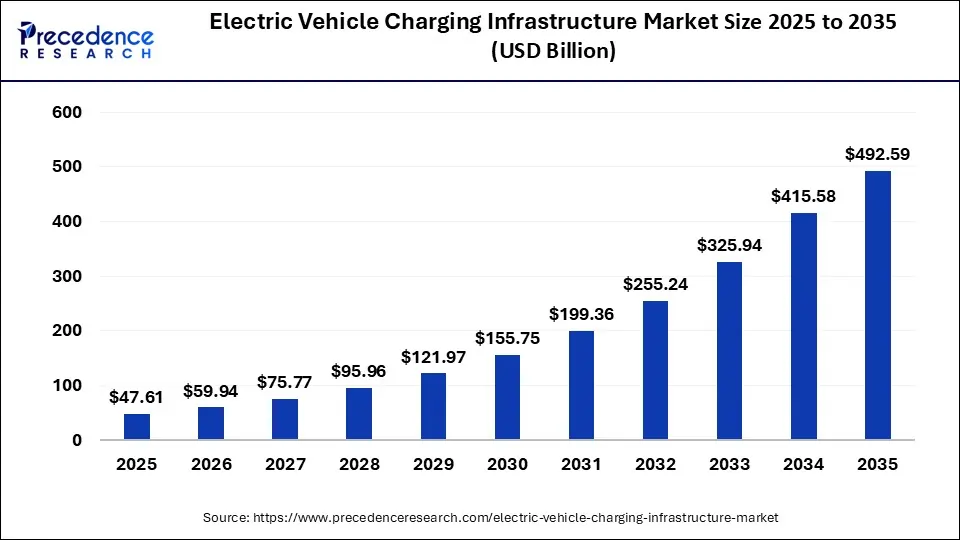
Why is EV Charging Infrastructure Becoming the Backbone of Future Mobility?
The shift toward electrification in transportation is no longer a trend it is a global mandate. Governments worldwide are implementing stricter emission norms and offering incentives, while automakers are rapidly expanding EV portfolios. As a result, the demand for reliable and widespread EV charging infrastructure has surged.
Additionally, declining lithium-ion battery costs, advancements in charging technologies, and increasing investments from both public and private sectors are strengthening the foundation of this market.
What Are the Key Market Highlights?
The market is expected to reach USD 238.82 billion by 2033, growing at a 25.0% CAGR.
Asia Pacific dominates the global market, accounting for over 68% share in 2025.
Fast chargers lead the market, contributing more than 73% share due to rising demand for rapid charging.
Level 2 chargers remain the most widely adopted, especially across residential and commercial applications.
Commercial charging infrastructure is expanding fastest, driven by fleet electrification and public charging networks.
How is Artificial Intelligence Transforming EV Charging Infrastructure?
Artificial Intelligence (AI) is emerging as a critical enabler in optimizing EV charging ecosystems. AI-driven platforms are being used to predict charging demand, optimize station placement, and dynamically manage load distribution across grids. This ensures efficient energy utilization and reduces operational costs.
Moreover, AI-powered smart charging solutions allow real-time monitoring, predictive maintenance, and personalized user experiences. These capabilities are particularly important as the integration between EV infrastructure and smart grids becomes more complex and data-driven.
What Are the Key Growth Factors Driving the Market?
1. Rapid Adoption of Electric Vehicles
The growing consumer shift toward eco-friendly transportation is significantly increasing the need for robust charging networks.
2. Government Policies and Incentives
Subsidies, tax rebates, and infrastructure mandates are accelerating deployment globally.
3. Declining Battery Costs
Affordable EV ownership is boosting adoption, indirectly driving charging demand.
4. Expansion of Public Charging Networks
Investments in highways, urban centers, and commercial hubs are strengthening accessibility.
Market Scope
| Report Coverage | Details |
| Market Size in 2025 | USD 47.61 billion |
| Market Size in 2026 | USD 59.94 billion |
| Market Size By 2035 | USD 492.59 billion |
| Growth Rate from 2026 to 2035 | CAGR of 26.32% |
| Largest Market | Asia Pacific |
| Base Year | 2025 |
| Forecast Period | 2026 to 2035 |
| Segments Covered | Charger Type, Connector Type, Application, and Region |
| Regions Covered | North America, Europe, Asia-Pacific, Latin America and Middle East & Africa |
What Opportunities and Trends Are Shaping the Future?
Is Ultra-Fast Charging the Next Big Breakthrough?
Yes, ultra-fast DC charging is rapidly gaining traction, especially along highways and for commercial fleets, reducing charging time to minutes.
Can Renewable Energy Integration Unlock New Value?
Absolutely. Solar-powered charging stations and grid integration are emerging as cost-effective and sustainable solutions.
Will Fleet Electrification Create New Demand?
Yes, ride-hailing, logistics, and autonomous vehicle fleets are significantly increasing demand for high-capacity charging hubs.
Industry Trends in EV Charging Infrastructure
How Smart EV Charging Stations Work
Smart EV charging stations rely on advanced backend systems that connect chargers to the cloud. This allows station operators to monitor and control charging in real time.
These systems collect data from connected vehicles and charging sessions, enabling stations to respond intelligently to factors such as:
Fluctuations in energy supply (especially from renewables)
Local electricity demand
Number of vehicles charging simultaneously
Nearby electricity usage
Because of this, charging can be optimized to reduce costs, avoid grid overload, and support renewable energy usage making the overall energy system more sustainable.
A key feature of smart charging is user identification. When a driver plugs in:
The system identifies the user
Links them to the charging session
Automatically calculates billing
Transfers payment to the station owner
Everything happens seamlessly in the background, creating a smooth and automated experience.
Wireless Charging for Electric Vehicles
Wireless charging, also known as Wireless Power Transfer (WPT), allows EVs to charge without cables.
Here’s how it works:
A transmitter coil is installed (e.g., under the road or charging pad)
A receiver coil is fitted in the vehicle
Energy is transferred between them using electromagnetic fields
Compared to traditional wired charging, WPT offers:
Greater convenience (no cables)
Reduced wear and tear
Safer and cleaner operation
Most EV wireless charging systems use resonant inductive coupling, which is efficient for medium- to high-power applications.
In October 2020, SAE International released the first global standard covering wireless EV charging systems, helping ensure compatibility and safety.
Charger Type Trends
EV chargers are broadly divided into:
Slow chargers (Level 1 & 2)
Fast chargers (DC fast charging)
Key insights:
Fast chargers dominate the market, accounting for ~89.6% share in 2025
The DC fast-charging (DCFC) segment is growing the fastest
This growth is driven by:
Government incentives and subsidies
Investments in public fast-charging infrastructure
The major advantage of significantly reduced charging time
Connector Type Trends
The main EV charging connector types include:
CHAdeMO
Combined Charging System (CCS)
Others
Among these, CCS leads the market with about 40.72% share in 2025.
Why CCS is Popular:
Combines AC and DC charging in one socket
Requires less space
Supports advanced communication via Power Line Communication (PLC)
Enables vehicles to interact with the grid (smart charging)
CCS has two variants:
CCS1 (used mainly in North America)
CCS2 (used in Europe and many global markets)
Notably, Tesla adopted CCS2 for its European vehicles, showing a shift toward standardization.
Regional Preferences:
China: GB/T standard
Japan: CHAdeMO
Europe & North America: CCS
The European Union mandates CCS2 connectors for new high-power DC chargers to ensure interoperability.
Application Trends
The EV charging market is divided into:
Commercial
Residential
The commercial segment dominates with about 90.42% share in 2025.
Why Commercial Charging Leads:
Rapid growth in EV adoption
Increasing demand for public charging stations
Limited home charging options (especially for renters or apartment residents)
Benefits for Businesses Hosting Charging Stations:
Increased customer footfall and sales
Stronger eco-friendly brand image
Additional revenue streams
Attraction of employees and customers
Business Models:
Owner-Operator – Business owns and manages the station
Third-Party Model – External company installs and operates it
Regional Market Insights (Asia Pacific & Beyond)
Asia Pacific (APAC)
The APAC market is growing rapidly:
Valued at $25.43 billion in 2025
Expected to reach $252.68 billion by 2035
CAGR: 25.81%
Key Countries:
China
Largest EV charging network globally
Over 1.2 million stations (as of 2019)
Plans to add ~600,000 more under infrastructure programs
Japan
Early investment led to oversupply of charging stations
Some stations now underutilized or being phased out
Aims for carbon neutrality by 2050
South Korea
Plans to install 3,000 fast chargers
Government actively supporting infrastructure expansion
Europe
Europe is expected to see the fastest growth rate due to:
Strong government policies
High EV adoption rates
Aggressive infrastructure targets
Key goals:
1 million public chargers by 2024
3 million by 2029
Countries leading adoption:
France, Netherlands, Germany, Norway, UK
A notable development:
ACCIONA Energía acquired a charging network from Shell Recharge in Spain and Portugal, gaining access to hundreds of charging points across high-traffic locations.
Electric Vehicle Charging Infrastructure Market Companies
- ABB
- BP Chargemaster
- ChargePoint, Inc.
- ClipperCreek, Inc.
- Eaton Corp.
- General Electric Company
- Leviton Manufacturing Co., Inc.
- SemaConnect, Inc.
- Schneider Electric
- Siemens AG
- Tesla, Inc.
- Webasto SE
Segments Covered in the Report
By Charger Type
- Slow Charger
- Fast Charger
By Connector Type
- CHAdeMO
- Combined Charging System (CCS)
- Others
By Application
- Commercial
- Residential
By Geography
- North America
- U.S.
- Canada
- Europe
- U.K.
- Germany
- France
- Asia Pacific
- China
- India
- Japan
- South Korea
- LATAM
- MEA
Get Sample Link: https://www.precedenceresearch.com/sample/1461
Also Read :https://www.newsgazzete.com/cold-chain-logistics-market/

